


|
|

 In English
 Suomeksi
Internal Design
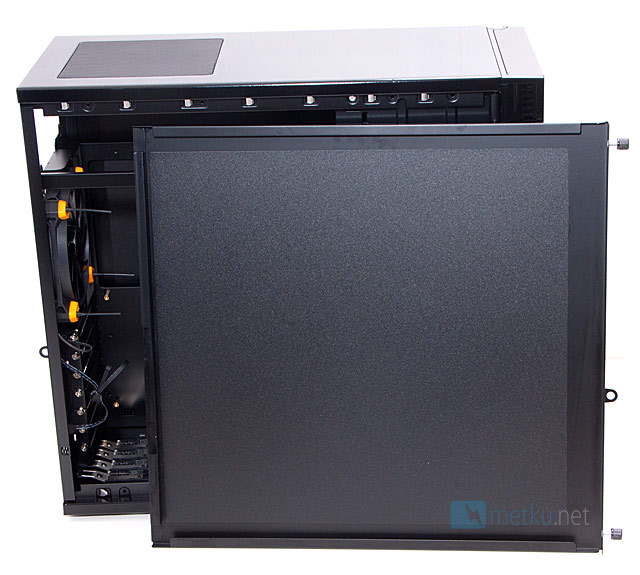
Removing the side panels we can see the sandwich-design used to make the case as quiet as possible. The dampening material used here is actually polycarbonate rather than bitumen or foam used in some cases. The hard polycarbonate layer makes the side panels rather heavy and very stiff, so they don't resonate.
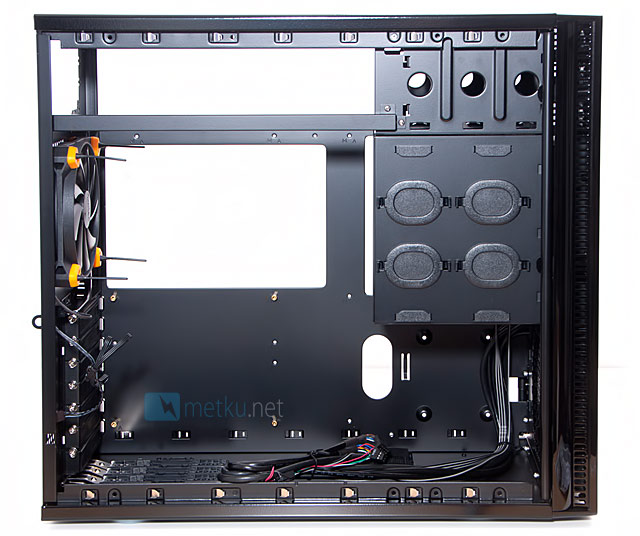
Looking at the internal design there are elements of the earlier Sonata-cases we've reviewed, but also some major changes. On the front there are the two 5,25" bays and three hard drive bays, but the drive bays are placed so high up there's room for any graphic card. Underneath the drive cages, on the motherboard tray, there are also mounting holes for a single 2,5" drive.
Talking of the motherboard tray it has a huge hole for installing the CPU-cooler, and also a couple of holes for cable routing. The case does have the PSU-support beam we've disliked in some cases, but luckily it's removable, so it doesn't cause problems in the installation. Finally as a nice detail the slides used for 5,25" drive installation are held in place at the bottom of the case.
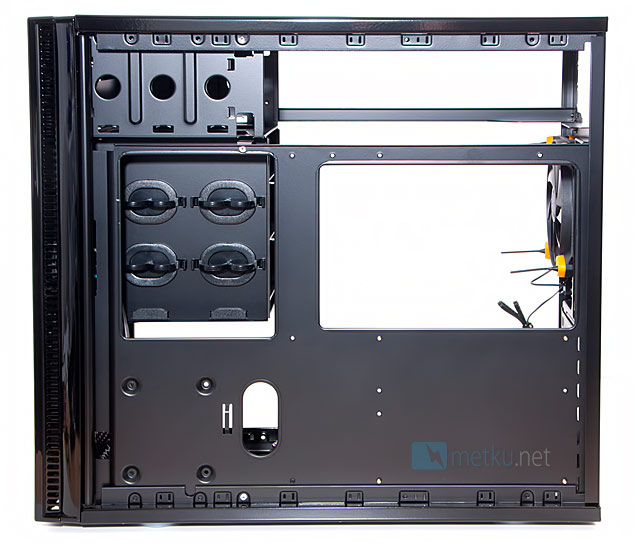
Looking at the flipside of the motherboard tray we can see that there's also a huge hole behind the hard drive bay. There are also hooks on the cage for cable management. There isn't a lot of space between the tray and the side panel, but due to the general layout of the case, there really is no need to route any thick cables behind the motherboard tray, either.
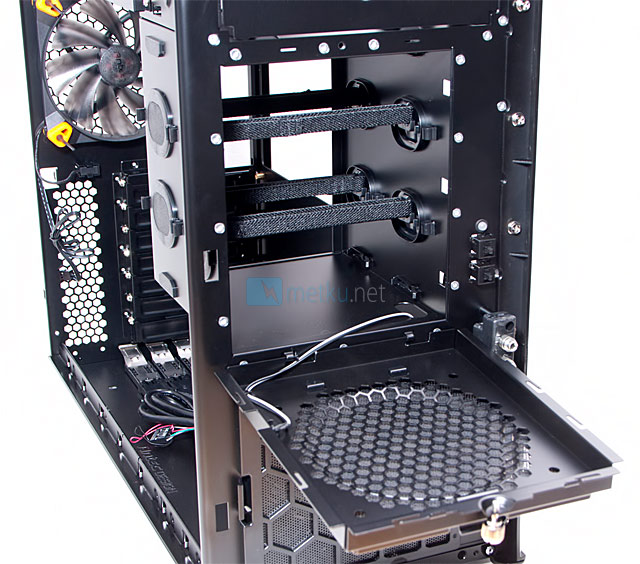
And here's a better look at the suspension mounting for the hard drives. The case also comes with three steel sledges with silicon grommets for mounting hard drives "the usual way", but if you're really looking for silence, these elastic mounts will be even better.
 | Pages: 1 2 3 4 5 |  |
 Content in english!
 Sisältö suomeksi!
