


|
|

Features
IDE and SATA controllers
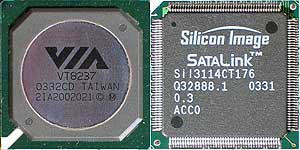
VT8237 & Sil3114
Storage capabilities of 8HDA3+ are extensive. VT8237 southbridge provides two IDE connectors and two SATA ports. In addition to that Silicon Image Sil3114 SATA controller provides four more SATA ports. Both SATA controllers have RAID capabilities.
I tested all controllers as usual. For IDE I used IBM 80GB 120GXP HDD and for SATA tests I used Seagate Barracuda 7200.7 SATA HDD. Next graphs shows HDTach 2.7 results.
HDTach 2.7
| Average read speed | CPU Utilization | |
| DFI Infinity 875 ICH5R SATA | 46.2 MB/s | 2.7% |
| Albatron K8X800 Pro II / Epox 8HDA3+ VT8237 SATA | 47.0 MB/s | 42.6 % |
| Epox 8HDA3+ Silicon image 3114 SATA | 46.8 MB/s | 40.4 % |
| Shuttle AN50R Silicon image 3112 SATA | 46.9 MB/s | 35.5% |
| DFI Infinity 875 HighPoint 372N | 39.4 MB/s | 2.3 % |
| DFI Infinity 875 ICH5R PATA | 39.1 MB/s | 3% |
| Albatron K8X800 Pro II / Epox 8HDA3+ VT8237 PATA | 39.2 MB/s | 41.2% |
| Shuttle AN50R nForce3 SPP PATA | 38.3 MB/s | 32.9% |
Both IDE and SATA controllers worked flawlessly, but HDTach recorded quite high CPU utilization. To verify result another test was performed, where big file was just copied from partition to partition and this time CPU utilization was under 10%. So it seems that HDTach is somewhat incapable to measure true CPU utilization on these Athlon 64 motherboards.
Audio
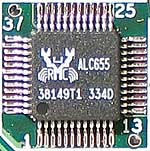
Realtek ALC650
Audio quality of Epox 8HDA3+s integrated audio solution is horrible. Headphone amplifier is absolutely unable to do its job and line-out is so bad that RightMark Audio Analyzer 5.1 was unable to measure how bad it actually is. Realtek ALC655 codec is shown to be actually quite good codec in some cases but combined to VT8237 AC97 audio controller result seems to be pretty bad.
RightMark Audio Analyzer 5.1 Analog
| General performance | Notes | |
| Terratec SoundSystem DMX 6Fire 2496 (dedicated sound card) | Excellent | Very good analog outputs |
| Philips Acoustic Edge (dedicated sound card) | Good | One of the best sound cards when using digital output |
| CMI9739A (integrated DFI Kt400A) | Average | Listening experience was better that test results |
| CMI9739A (integrated Epox PDA2+/DFI Infinity 875) | Average | Listening experience was worse that test results |
| Soundmax AD1985 (integrated) | Good | Probably best integrated audio device. |
| VIA Envy24PT (integrated) | Good | Excellent features |
| Realtek ALC650 (integrated Shuttle AN50R) | No result | Produces noise when it should repeat something as good as possible |
| Realtek ALC655 (integrated Epox 8HDA3+) | No result | Not suitable even for testing |
Tests are driven by using analog output and input (16-bit 44KHz).
RightMark Audio Analyzer 5.1 Digital
| General performance | Merkintöjä | |
| CMI9739A (integrated DFI Infinity 875) | Excellent | Digital output is very solid but input could be better |
| VIA Envy24PT (integrated Albatron K8X800 ProII) | Excellent | Solid performance |
| Philips Acoustic Edge (dedicated sound card) | Excellent | Record holder |
| Realtek ALC650 (integrated Shuttle AN50R) | No result | No digital output |
| Realtek ALC655 (integrated Epox 8HDA3+) | No result | Not suitable even for testing |
Tests are driven by using digital output and input (16-bit 48KHz).
This time even digital outputs, which are supposed to be good cause no DA conversion is required, seemed to be useless. Something has gone totally wrong and even digital output seemed somehow altered and test program couldnt perform tests. It really seem that this audio solution is totally useless, actually so useless that there could be some kind of problem on our test sample.
LAN
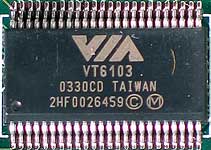
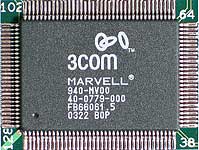
VIA VT6103 & 3Com 3C940
VIA VT6103 and 3Com 3C940 network controllers have proven to be quite good on our past tests, so its good to see that Epox has chosen them on this motherboard. VIA VT6103 is ordinary 10/100-megabit network controller whereas 3Com can operate even at one-gigabit speed. We didnt encounter any kinds of compatibility or other problems on our tests.
100 Mbps network
| Transfer rate | CPU load | |
| Nvidia MCP 10/100 (AMD) | 9692kB/sec | 10-20% |
| RTL8101L 10/100 (AMD) | 9692kB/sec | 30-40% |
| VIA VT6103 10/100 (AMD) | 9692kB/sec | 20-30% |
| 3Com 3C940 10/100/1000 (AMD) | 9692kB/sec | 30-40% |
| 3Com 3C940 10/100/1000 (P4) | 9692kB/sec | 4-10% |
| BroadCom BCM5705 10/100/1000 (P4) | 9692kB/sec | 4-10% |
| Intel 82547EI ET LAN (CSA)(P4) | 9692 kB/sec | 2-15 % |
| Intel RC82540EM (AMD) | 9692 kB/sec | 5-12% |
| nForce3 SPP (AMD) | 9692 kB/sec | 40-50% |
Gigabit network
| Transfer rate | CPU load | |
| 3Com 3C940 10/100/1000 (Albatron K8X800 Pro II) | 19MB/sec | 70% |
| 3Com 3C940 10/100/1000 (Epox 8HDA3+) | 19MB/sec | 35-40% |
| Intel RC82540EM (Shuttle AN50R) | 17MB/sec | 30-40% |
Maximum transfer rate was tested using SiSoft Sandra 2003 and CPU load test was performed by transferring big file from machine to machine at the same time as I manually monitored CPU load. Transfer rate is limited by another system which I use on 100Mbps tests.
High CPU utilization seems to strain AMD systems on these tests too. VIA VT6103 managed to pull out quite good score only loosing to Intel RC82549EM. Compared to VIA VT6103 3Coms controller seems to suffer from even higher CPU utilization. On gigabit network 3Com network controller on Epox seem to be somehow much better than just a same controller on Albatrons motherboard. Device drivers and tests setup was absolutely some on both motherboards, so test results are somewhat mystery to me.
Dual LAN is always welcome feature and both controllers worked very well on our tests. Nice job from Epox on this area.
 | Pages: 1 2 3 4 5 6 7 |  |
 Content in english!
 Sisältö suomeksi!
