


|
|
| Product Name | RADEON 9600 128MB | RADEON 9600 PRO 128MB | RADEON 9600 XT | RADEON 9800 XT |
| SMARTSHADER™ | 2 | 2 | 2 | 2.1 |
| SMOOTHVISION™ | 2.1 | 2.1 | 2.1 | 2.1 |
| FULLSTREAM™ | Real, DivX | Real, DivX | Real, DivX | Real, DivX |
| Adaptive De-Interlace | VIDEOSHADER | VIDEOSHADER | VIDEOSHADER | VIDEOSHADER |
| HYDRAVISION™ | Yes | Yes | Yes | Yes |
| Clock Speed Core/Memory(MHz) | 325/400 | 400/600 | 500/600 | 412/730 |
| Pixel Fillrate | 1.3 Gpixels/sec | 1.6 Gpixels/sec | 2.0 Gpixels/sec | 3.3 Gpixels/sec |
| Geometry Rate | 162.5 Mtriangles/sec | 200 Mtriangles/sec | 250 Mtriangles/sec | 412 Mtriangles/sec |
| Bus Type | AGP 4X/8X | AGP 4X/8X | AGP 4X/8X | AGP 4X/8X |
| Power Requirement | - | - | - | 300 W |
| Memory Amount | 128 | 128 | 128 | 256 |
| Memory Type | DDR1 | DDR1 | DDR1 | DDR1 |
| Memory Interface | 128-bit | 128-bit | 128-bit | 256-bit |
Quick feature copy from ATi's site. Only thing here setting these 9600 XX cards apart is the clock speed. 9600 XT also includes a nifty feature from 9800 XT core; a temperature diode. It offers something new for overclockers but more on this on next page.
Card
Front
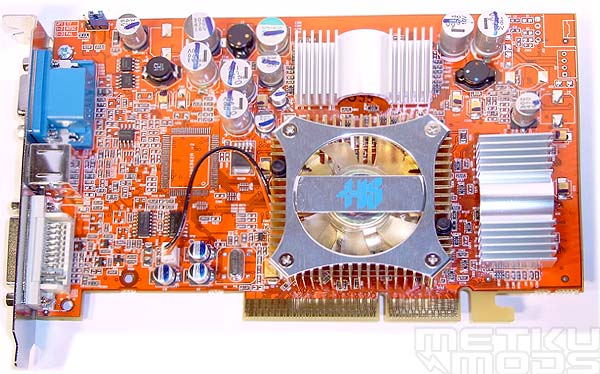
Card is based on the reference design from ATi. Perhaps this is something that doesn't need to be mentioned because manufacturers usually change only the cooling on these cards. Most of them doesn't even bother to do that.
Core cooler
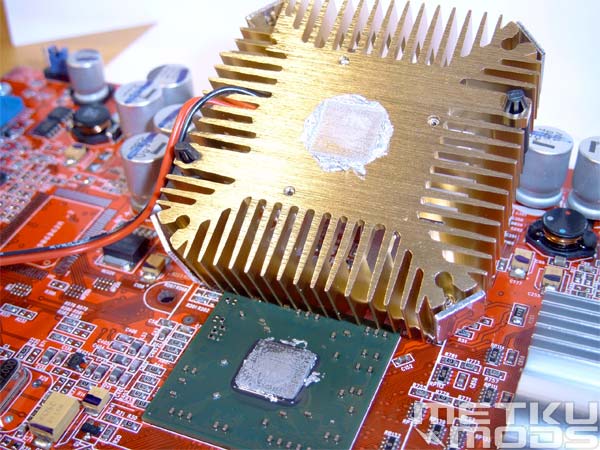
Heatsink is made out of anodized aluminum. It is a fairly large block and has big fins for maximum heat transfer. There were some signs of scratches on the surface of the heatsink but the scratches weren't too deep and they can be easily removed by lightly lapping the bottom. Heatsink is attached to the card with two plastic tabs that utilize springs to produce more pressure against the core. Between the core and the heatsink one should find a good amount of silver compound.
Core
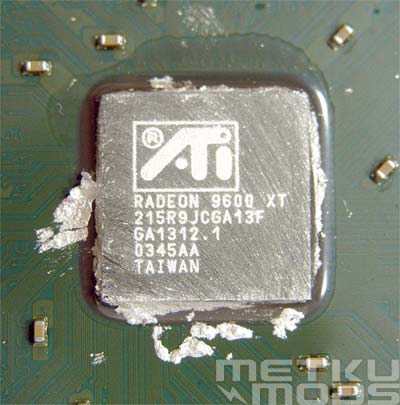
As you can see the silver compound isn't the highest in quality. Texture is quite grainy but it still does its job pretty well because we didn't have any problems with heat in our tests. Actually, I was very surprised how cool the card was after long gaming sessions and 3D modelling.
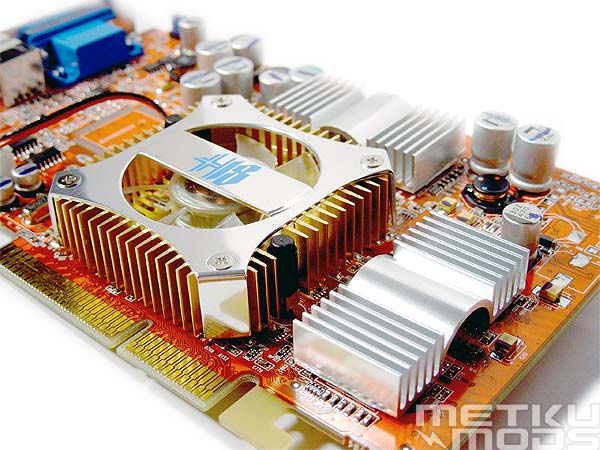
Memory cooling - Front
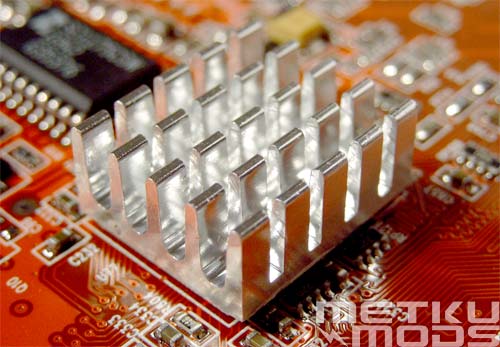
Memory cooling - Back
It is nice to see fairly large RAM sinks on the backside of the card. RAM sinks on the both sides are actually glued in place so the heat transfer should be good. All I can say is that HIS have done great job with cooling of the card and this also adds a nice bonus by enchancing the looks of the product.
Will these RAM sinks offer better overclocking results? What I have gathered from the net, the card uses Samsung's K4D263238E-GC2A chips. These chips are rated to 350 MHz (DDR700) and HIS is running them on 650 MHz DDR. This should offer some good overclocking results but this remains to be seen on the next page.
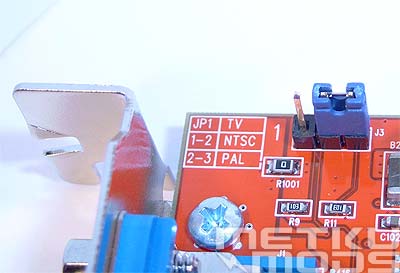
TV out system
Giving user a possibility to change the TV signal standard is a good thing. Same card can be sold in all continents and if you take a trip, for example to US, buy the card and bring it home where you have PAL standard everything should run smootly.

Connectors
Pretty standard stuff. Most cards today have these three connectors that provide analog video signal for monitors, SVideo for TV sets and DVI for TFT-displays and with a bundled converter for second analog monitor. TV out quality is in par with previous products based on ATi's technology. In short; It is great! Movies and games look really good on TV and it is hard to imagine that the quality could be any better than this with a regular TV.

Blue led fan
Led fans are getting more and more popular but perhaps this product could have survived without it. It is quite useless to include lights to a fan that is facing towards the floor of the case and that can't be seen thought the side window. On the other hand it doesn't hurt to have lights so you decide if you like it or not. Fan itself is really quiet and does a good job keeps the core cool.
 | Pages: 1 2 3 4 |  |
 Content in english!
 Sisältö suomeksi!
